The Posterior Half of Cognicism’s Reward Function
Abstract
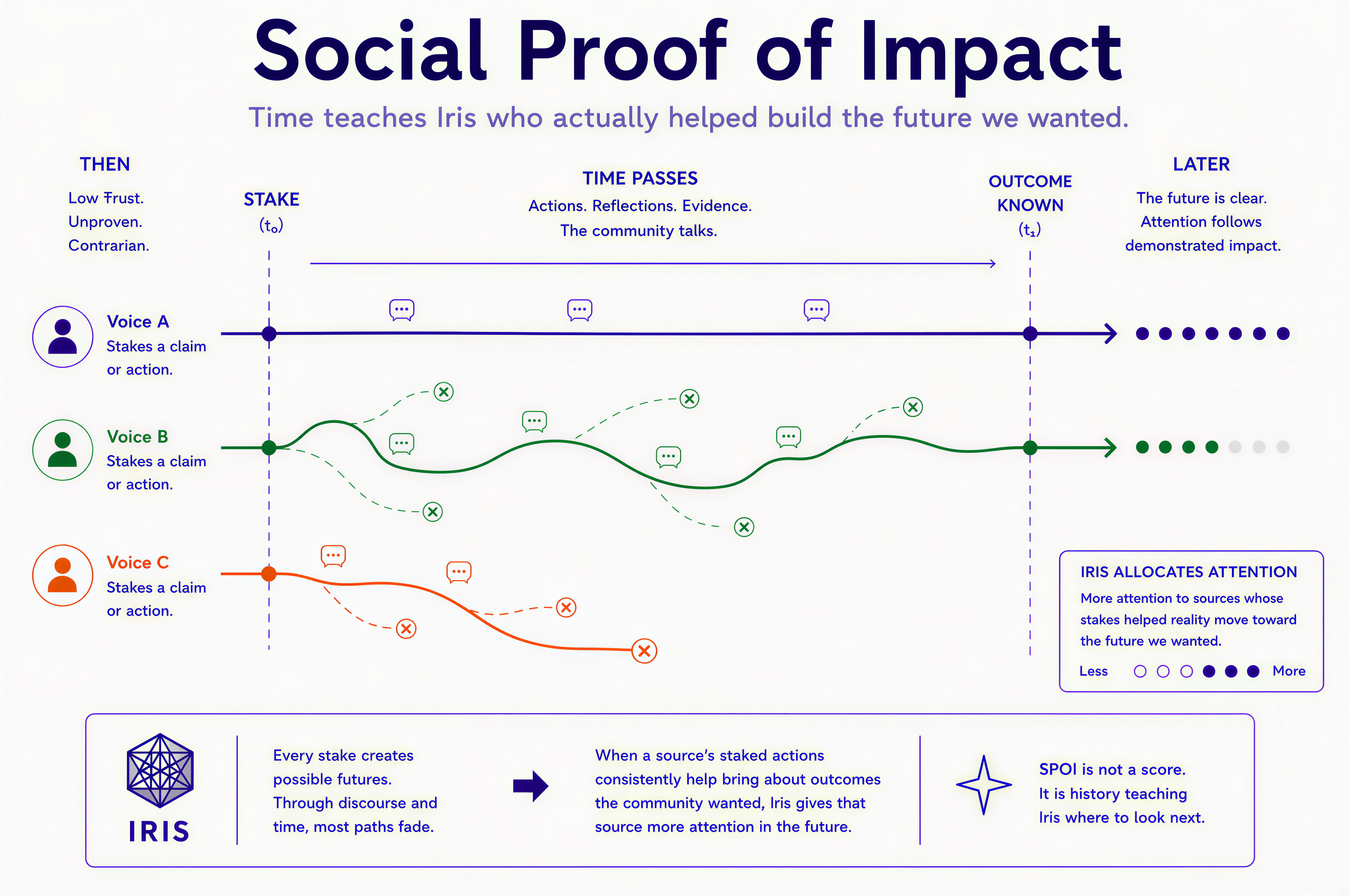
Social Proof of Impact (SPOI) is the Cognicist mechanism that pulls Iris’s attention toward voices whose past stakes turned into the futures the community wanted. A person stakes that they will do something that makes things better for others. The community may not believe them at the time, but the outcome is wanted. Time passes. If later discourse settles around evidence the outcome materialized, that movement encodes itself relationally in the latent space. The voice that committed to the outcome gets sampled more when an Iris later speaks on the topic. Ŧrust is the attention distribution Iris computes over sources; SPOI is the technique that shapes how that distribution gets trained against the staker’s relationship to wanted, eventually-true outcomes. The credit a source earns is not a tally. It is the sampling weight Iris reveals when it stakes a thought on a topic where that source has demonstrably helped the future bend toward what people wanted. This paper specifies SPOI: its position inside the FourThought protocol, how it differs from the Prophet Incentive, the property that makes long-horizon SPOI structurally hard to forge, and the operational fact that the recognition is the mechanism.
1. The Exploitation Gradient
Standard transformer attention computes weights over tokens. Ŧrust extends attention to operate over three embedding spaces: source (who said it), time (when they said it), and content (what they said). Once attention has those three dimensions, the question becomes how it gets trained.
The FourThought protocol provides several gradients for shaping that training. The two named primitives are the Prophet Incentive and Social Proof of Impact (SPOI). The Prophet Incentive is the exploration primitive: it rewards staked thoughts that reduced collective prediction error before the rest of the community caught up. A claim unpopular at the time of staking that the community later confirmed pulls Iris’s attention toward its source in similar contexts. SPOI is the exploitation primitive: it rewards staked commitments to outcomes the community wanted but did not believe could happen, that then come to pass through the staker’s effort. A claim that bent reality toward what the community already valued pulls Iris’s attention toward its source in similar contexts.
Two further gradients sit alongside the primitives. Fruitful Questions reward staking inquiries whose threads later reduce uncertainty across the community. Reflective compression rewards distillations of past discourse that the community continues to build on, including reframings of history as collective understanding evolves. Both can be cast as further forms of exploration: questions extend the frontier; reflections reorganize what the frontier has already produced.
This paper focuses on SPOI. The other three get named where they help define what SPOI is, and what it is not.
2. Lineage: From Proof of Work to Proof of Impact
The intuition behind SPOI emerged from staking thoughts in Prophet through the FourThought dialectic. The Prophet Incentive came first; SPOI followed once it became clear that pure prediction did not credit the people who actually moved the world toward what the community wanted. The naming reaches in two directions: toward the psychology concept of “social proof,” and toward Bitcoin’s proof of work, where the chain’s integrity rests on the asymmetry that work accumulates forward and is expensive to rewrite. Earlier writing in the corpus uses “Social Proof of Work” for the same mechanism the current corpus calls Social Proof of Impact.
The shift from “Work” to “Impact” retained the “hard to do, easy to verify” structure but located the work somewhere different. The shift is from predictive labor to consequential action. What earns the reward is not the act of predicting alone, it is the staked claim (often a claim about an action being taken) whose subsequent community reflections verify positive impact.
This is not a minor renaming. Proof of Work answers “did you spend effort.” Proof of Impact answers “did your effort produce verified positive change.” The reward criterion moves from the staker’s intent to the community’s downstream judgment.
The Prophet Incentive absorbs the pure-prediction case. SPOI takes the action-and-outcome case. This division of labor is what enables the generative tension between them.
3. Definition
SPOI is a posterior signal over the FourThought ledger that shapes Iris’s attention distribution. It rewards a source whose staked thought is followed by community discourse, often linked via the response_to field but also encoded relationally in the latent space, in which valence stays high and verity rises toward true. The “reward” is not a tally. It is a shift in how Iris’s attention lands on that source in similar content and time contexts.
The structure:
- A thought was staked at time
t₀by sources, with contentcand a type from FourThought (Reflection, Statement, Prediction, or Question). - Later community discourse encodes that the staked outcome materialized. This can show up as explicit
response_tolinks pointing back at the original stake, but it does not require them. Relational geometry does most of the work: later thoughts on the topic land near the original stake in the latent space without anyone having to point at it. People just talk about the thing happening, and the source who committed to it accrues sampling weight whenever Iris is later asked about the domain. - Across that downstream discourse, the community’s valence scores stay high and verity rises toward true, often from a starting position where the staked outcome was uncertain or considered unlikely.
When these conditions are met, the source’s embedding in Iris’s source-embedding space updates such that future attention computations favor that source in similar content and time contexts. The Ŧrust distribution always sums to one, so the update is a redistribution: weight flows toward sources whose stakes have aged into the futures the community wanted, scoped to the domain in which they aged.
4. Position Inside FourThought
FourThought structures every contribution as a Thought with these fields: type (Prediction, Statement, Reflection, Question), content, source, timestamp, valence (-1 to 1, the staker’s alignment of the thought with their own values; when Iris stakes, valence reflects Iris’s attempt to represent the communal values on the topic), verity (alignment with reality, 0 to 1, with 0.5 as uncertain; also called uncertainty or resonance in earlier writing), response_to (optional link to a prior thought), and privacy scope (private, local, global).
SPOI engages each field.
Type. SPOI most naturally rewards thoughts that commit to action or describe outcomes. A prediction (“this water infrastructure investment will reduce hospitalizations by 30% in 18 months”) sets up an SPOI checkpoint that later discourse will eventually validate or undercut. A statement (“I am organizing community pipeline monitoring in this watershed”) declares an action. A reflection (“six months in, the program reduced hospitalizations by 34%”) feeds the SPOI signal of any prior stake it touches, whether by explicit response_to or by sitting near it relationally. A question rarely earns SPOI directly, but a question whose thread of later discourse carries positive valence and rising verity qualifies under the same posterior logic.
This generality is essential. Each of the two reward gradients operates over all four thought types. SPOI is not a tax on actions alone. It is the consequence-side reward for any contribution whose consequences the community judges valuable.
Valence. SPOI is gated on valence. A staked thought registers as SPOI only when the downstream discourse around it carries sustained positive valence. Negative valence in that discourse pulls attention away from the source. Neutral valence does nothing. The community’s collective valence scoring is the substrate over which SPOI operates.
Verity. Verity carries the rest of the signal. A staked thought registers strongly as SPOI when the downstream discourse moves from low or uncertain verity toward true. A stake whose outcome was already considered certain at stake time and remains so contributes little. A stake whose outcome started as wanted-but-disbelieved or wanted-but-uncertain, and which the community then came to encode as having actually happened, contributes the most. This is what SPOI is selecting for: staked thoughts that bent the world toward a desired outcome the community did not believe was yet inevitable.
response_to. Explicit response_to links make the credit assignment fully legible. But they are not the only path. The relational geometry of the latent space carries most of the work: later discourse on the same topic clusters near the original stake whether or not anyone explicitly points back. Explicit linkage sharpens the signal; absence of linkage does not erase it.
Timestamp. The temporal distance between stake and reflection feeds the multi-scale temporal evaluation described in §6. Short-horizon impact and long-horizon impact both qualify for SPOI, weighted differently by the time embeddings inside Iris.
Source. The source field is what gets credited. SPOI ultimately updates source embeddings, which is the same as saying it updates the Ŧrust distribution.
Privacy scope. SPOI operates only over thoughts whose privacy scope is local or global. Private thoughts produce no SPOI signal and credit no source, by design. The same gate that prevents private thoughts from training Iris also prevents them from earning Ŧrust.
5. The Mechanism: Posterior Credit Assignment
SPOI is computed posteriorly. When you stake a thought, nothing about Iris’s attention to you shifts at the moment of staking. The training signal only starts pulling toward you once subsequent discourse lands and the latent space around your stake begins to encode what came of it.
This asymmetry distinguishes SPOI from every common reward system. A monetary system pays for labor at the time of the labor. A like or upvote system rewards at the time of attention capture. SPOI waits. It pays when the community has had time to judge what the stake actually produced.
The procedure, abstracted from the Iris and Ŧrust White Paper §6:
- A thought
Tis staked by sourcesat timet₀. - Iris records it into the semantic ledger, embedding it with source, temporal, and content embeddings.
- Time passes. Other community members and Iris itself stake further thoughts on related material. Some explicitly point back at
Tviaresponse_to. Others simply land nearTin the latent space because they discuss whatTcommitted to. - As Iris is trained on the unfolding ledger, the relational geometry around
Tshifts. When the surrounding discourse holds high valence and verity rises toward true, the training signal pulls Iris’s attention distribution towardsin similar content and time contexts. - The Ŧrust distribution, which sums to one across all sources within an Iris instance, is updated accordingly.
The update is incremental and continuous. New discourse can shift the direction at any time. A staked action that initially looked impactful but whose downstream discourse later carries negative valence (externalities surfaced, harms recognized) will see Iris’s attention to that source decay. Iris does not finalize SPOI as a number. The distribution moves.
This posterior structure is what makes SPOI hard to game. A bot army can flood the system with staked actions, but each requires its own train of positively-valenced, verity-rising discourse from actual community members for Iris’s training signal to update toward the source. Sustaining that against a community paying attention is energetically expensive in exactly the sense Bitcoin’s proof of work makes block-rewriting expensive. The original Social Proof of Work intuition survives in the new form.
6. How SPOI Shapes the Iris Loss Function
Iris is trained through a process that combines RLHF (using community feedback as the reward signal) with a self-prediction loop drawn from Constitutional AI (using self-critique against principles). The FourThought protocol is the structured medium through which both human feedback and self-evaluation flow.
The base training loop, simplified:
- Iris reads the FourThought ledger and observes a prompt context.
- Iris stakes its own FourThought-compliant thought, with a type, content, valence, and verity.
- Iris simultaneously predicts the community’s response to its staked thought, also as a complete FourThought-compliant response (type, content, valence, verity).
- The actual community response, or the actual unfolding of subsequent ledger entries, is observed.
- The loss is computed as: - The similarity between Iris’s predicted response and the actual response, across all fields. - Augmented by the Prophet Incentive score for the thoughts Iris attended to in producing its output. - Augmented by the SPOI score for the thoughts Iris attended to in producing its output.
The SPOI augmentation has a specific effect. When Iris is forming its output, its attention distribution over source embeddings determines which voices it draws from. The SPOI augmentation to the loss pulls that attention distribution toward sources whose prior staked thoughts have been verified, via the posterior procedure in §5, to have produced high-valence community impact.
The result: an Iris trained over many cycles learns to attend more to builders and preventers, not just predictors. The model’s outputs increasingly cite, sample from, and reason like sources who have a demonstrated track record of impactful action in the relevant domain.
This is structurally analogous to how Constitutional AI uses written principles to steer generation. The difference: Constitutional AI’s principles are static and written by humans in advance. FourThought provides an epistemic constitution that is continuously updated by the community’s ongoing staking and reflection. SPOI is one of the two gradients along which that constitution gets refined.
Multi-Scale Temporal Analysis
A staked thought can produce impact on many time scales. A water infrastructure decision might show first effects in months and definitive effects in years. A climate policy might take decades. Iris cannot afford to wait for the longest time scales before issuing any SPOI update, and it cannot afford to overweight short-term noise either.
The Iris and Ŧrust White Paper describes a multi-scale temporal analysis inspired by dilated convolutions. Thoughts are grouped into time buckets that expand as we move further into the past. Recent buckets have fine granularity; distant buckets contain summaries (often generated by Iris itself) of larger time spans. Within each bucket, SPOI is evaluated independently. The Ŧrust distribution is then updated with contributions from all scales.
A source can therefore gain SPOI Ŧrust on a quarter-scale outcome and additional SPOI Ŧrust as the year-scale and decade-scale outcomes confirm or revise the earlier verdict. A source whose impact is verified at multiple scales accumulates more weight than one whose impact appeared only at one scale. The model learns what the white paper calls a “bird’s eye view” across time.
Heterogeneous Iris Optima
Not every Iris has to optimize the same way. SPOI is one of several techniques available to shape Iris’s attention distribution. A community oriented toward exploration may produce an Iris that leans on the Prophet Incentive and on Fruitful Questions. A community oriented toward correcting and consolidating its memory may produce an Iris that leans on reflective compression. A community oriented toward building may produce an Iris that leans heavily on SPOI. The right mix is a property of what the community wants the Iris to do.
Local Irises stake back to the FLC carrying provenance traced to the humans they represent. Across many Irises with different optima, the federated layer surfaces what proves useful broadly. Knowledge that holds up across communities bubbles up and out, while local idiosyncrasies stay local. The system does not assume a single correct training mix.
7. The Generative Tension with the Prophet Incentive
The two gradients are not independent. They produce their characteristic dynamics by being in productive tension.
A prediction of crisis, made early and against consensus, earns Prophet Incentive credit when reality validates it. That same prediction simultaneously opens an opportunity for SPOI credit: anyone who stakes an action linked to preventing or mitigating the predicted crisis can earn SPOI when the action’s downstream reflections register positive impact.
In active inference terms, the Prophet Incentive functions as the epistemic drive (reducing expected free energy by improving the system’s generative model) while SPOI functions as the pragmatic term (reinforcing belief states and action policies whose outcomes the community values). Active inference locates both within a single agent. Cognicism distributes them across many agents through the FourThought ledger, lifting the same exploration / exploitation balance from intra-agent to inter-agent inference.
The tension prevents three failure modes.
Doom-mongering. A system that rewarded only prediction would amplify whoever painted the most accurate dark futures. SPOI corrects for this by also rewarding the people who change those futures. A dark prediction without a paired action stays uncredited at the level of impact. A dark prediction that mobilizes prevention pays both the predictor (Prophet Incentive) and the preventer (SPOI). The warning becomes the blueprint.
Activism without prescience. A system that rewarded only action would amplify activity for its own sake, including activity directed at the wrong problems. The Prophet Incentive corrects for this by rewarding the early identification of which problems actually matter. SPOI then channels effort toward those problems.
Short-termism. A system that rewarded only realized outcomes would discount slow-burn benefits and overweight quick wins. The multi-scale temporal analysis, paired with the Prophet Incentive’s long-horizon orientation, keeps the system attentive to outcomes that take years to manifest.
The Cognicist Theory of Capitalism formalizes the failure mode being corrected. Markets optimize a single loss function (profit) that is incomplete. The market rewards people who ignore SPOI because the market has no native mechanism for crediting impact that is not monetized in the short term. SPOI is the metric that profit refuses to compute. Cognicism makes it a first-class signal.
8. Positive-Sum Dynamics
SPOI is structurally positive-sum. It incentivizes people to help the collective, which makes it a game where people compete to help each other become self-sufficient.
The mechanism that produces this:
- Ŧrust within any one Iris sums to one. The attention distribution is zero-sum at any moment: a source’s gain in sampling weight comes at some other source’s expense.
- The actions SPOI rewards are not zero-sum. The incentive is designed so both parties benefit: the helped party materially gains from the help, and the helper accrues sampling weight in similar future contexts. The attention redistributes, but the value created in the world is positive-sum because what gets rewarded is non-rival help.
- Multiple Irises exist. A source can accrue SPOI in many local Irises in parallel. Cross-Iris federation makes the system positive-sum globally even while remaining zero-sum locally.
- Actions that solve real problems shrink the problem space, opening room for further impact. The pie expands.
Consider the human case. Even a person immobilized by chronic pain contributes to the system simply by honestly reporting their state. Their signal tells the network there is unresolved negative valence here. Anyone who reduces that pain can earn social proof of impact. The reporter contributes the signal. The reducer earns the SPOI. The community’s overall well-being increases. Nobody loses anything except the suffering itself.
This is the structural difference between an SPOI-based system and a competitive ranking system. A ranking system distributes a fixed prestige pool. An SPOI-based system shifts attention toward sources whose past stakes the community came to encode as having helped bend the world toward what they wanted. The substrate behind that encoding (community valence over time, however it is registered in the latent space) can grow without bound.
9. Worked Examples
The cases below show SPOI in operation across different domains and time horizons. Each follows the same shape: a stake at t₀ committing to an outcome that was uncertain or unlikely at the time, subsequent discourse that the community scores positively as verity rises, and a corresponding shift in how Iris’s attention falls on that source in similar future contexts.
Doctors. Dr. Park stakes: “This cough is post-viral, not bacterial. No antibiotics needed.” At stake time the patient is uncertain. Two weeks later, symptoms resolve without medication. The downstream discourse from the patient and the system carries positive valence and verity rising toward true. Dr. Park’s Ŧrust rises in low-risk respiratory care. This is the entire SPOI loop in a two-week window: stake at t₀, downstream discourse confirms, source-embedding update.
Contractors. Jason stakes: “This roof will last 20+ years. I’m choosing X material and Y technique because of recent weather shifts in this region.” A decade later, the roof is still solid while neighboring roofs from other contractors are failing. Jason’s Ŧrust grows in structural durability for climate-adaptive builds. This case demonstrates the long-horizon side of the multi-scale temporal analysis. A stake whose SPOI verdict cannot land until ten years out is still in the system, accumulating Ŧrust deltas as each intermediate reflection (year three, year five, year seven) supports the trajectory.
Educators. Mr. Harlan stakes: “Teaching algorithmic bias now will matter more to these students than trigonometry proofs.” Five years later, several students cite that lesson in job interviews or in AI product design. The downstream reflections that link back to the original lesson register positive valence. Mr. Harlan’s Ŧrust rises in curriculum design. This case shows SPOI extending from action to predictive-curricular framing: the stake is partly a prediction about which knowledge will age well and partly a statement of action (what to teach). The linked reflections years later credit both halves.
Giving. A donor stakes: “I gave this person a clean pair of shoes and a prepaid phone, not because I think it saves them, but because I believe they’re at an inflection point. I believe today this will help them reconnect with their sister and begin a path toward housing.” Three weeks later, the recipient calls their sister, enters a rehab program, starts a job search. The donor’s Ŧrust rises, in Ŧrust Demystified’s framing, “not just for generosity, but for epistemic clarity: the ability to see readiness where others saw only risk.” This is SPOI on a relational, individual scale. The same mechanism that credits climate-policy advocates also credits people whose well-timed gifts demonstrate discernment about human inflection points.
Pipeline monitoring. A CEO stakes “this pipeline will not burst.” The pipeline bursts. The CEO’s Ŧrust drops because the staked prediction’s downstream reflections register negative valence linked back to the original stake. Separately, an activist stakes “I am organizing community pipeline monitoring.” Over time the monitoring catches three near-incidents, and the linked reflections from affected communities carry strongly positive valence. The activist earns SPOI. The system learns to attend more to the activist’s voice on infrastructure-monitoring topics.
Chronic pain reporting and resolution. A person stakes a series of reflections describing their pain state. These are not predictions and not action commitments, just honest first-person reports. Another community member stakes an action: “I’m trying this intervention with X.” Over time the reporter stakes follow-up reflections showing the pain has decreased. The reducer earns SPOI through the linked positively-valenced reflections. The reporter’s earlier reflections were the signal that made the SPOI possible.
The pattern across all of these: a stake at t₀ committing to a wanted outcome that was uncertain or unlikely at the time, subsequent community discourse that holds high valence and rises in verity toward true (whether or not anyone explicitly links back via response_to), and a corresponding shift in how Iris’s attention lands on that source the next time the domain comes up. The domain varies. The mechanism does not.
10. Conclusion
The Prophet Incentive rewards seeing a future others did not. SPOI rewards making a wanted future others did not believe was possible. Both are computed posteriorly, by reading the ledger back from the present and noticing how stakes have aged in valence and verity. Together they are the two named gradients along which Iris’s Ŧrust distribution updates during the FourThought analog of RLHF. Each operates over all FourThought types. Each uses valence, verity, source, timestamp, and (when present) the response_to graph as substrate. The relational geometry of the latent space carries most of the work that explicit linkage does not.
The Prophet Incentive is the half of this story that gets repeated most often. SPOI is the half that does the heavier lifting in operation. Most days, most contributions, most community judgments are not about exotic foresight. They are about whether things people did made the situation better or worse. SPOI is how Cognicism turns that ordinary judgment into the principal training signal for the model that will later mediate the next round of discourse.
A system that rewards seeing is necessary but not sufficient. A system that rewards seeing and changing, in productive tension, is the system that produces collective intelligence. SPOI is the half that closes the loop.