How the Market Rewired Elon Musk
by John Ash
“The most likely outcome is that AI and robots make everyone wealthy. In fact, far wealthier than the richest person on Earth.”
Elon Musk, November 19th 2025
“Whoever said ‘money can’t buy happiness’ really knew what they were talking about.”
Elon Musk, February 5th 2026
Introduction
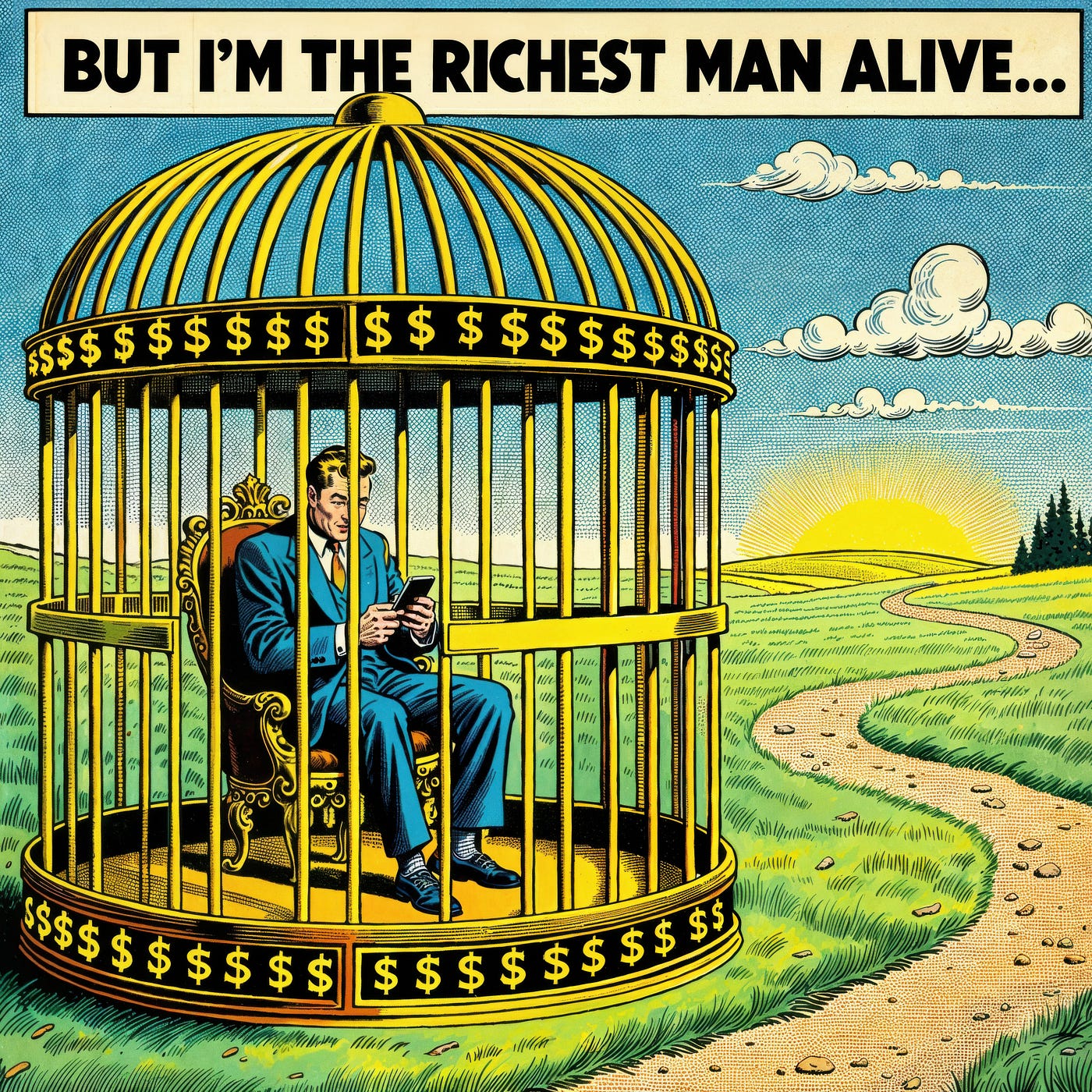
This is not a hit piece. It is a question: what happens to a person when the system they operate in rewards them more than any human being in history, and the reward never stops?
Elon Musk once warned that delaying the transition to renewable energy could cause “more displacement and destruction than all the wars in history combined.” He left a presidential advisory council over climate policy. He called climate change “the biggest threat that humanity faces this century.” He built the most successful electric vehicle company in the world.
Today, that same person funds climate denial, dismantles environmental regulation, criticizes the very policies that made his company possible, censors critics while calling himself a free speech absolutist, and promises that AI will make everyone rich while actively destroying the institutions that redistribute wealth. These are not minor inconsistencies. They are a pattern. And the pattern has an explanation.
There is a theory of capitalism that predicted all of this. It argues that profit doesn’t just shape what people do. Over time, through repeated reinforcement, it reshapes how they think. The system doesn’t just reward short-term behavior. It rewires the people inside it, pulling their attention toward whatever makes the number go up and away from everything else. The more successful you are, the more complete the rewiring. And the more complete the rewiring, the less you can see that it happened.
Musk is not the villain of this story. He is its most vivid illustration.
1. The Original Vision
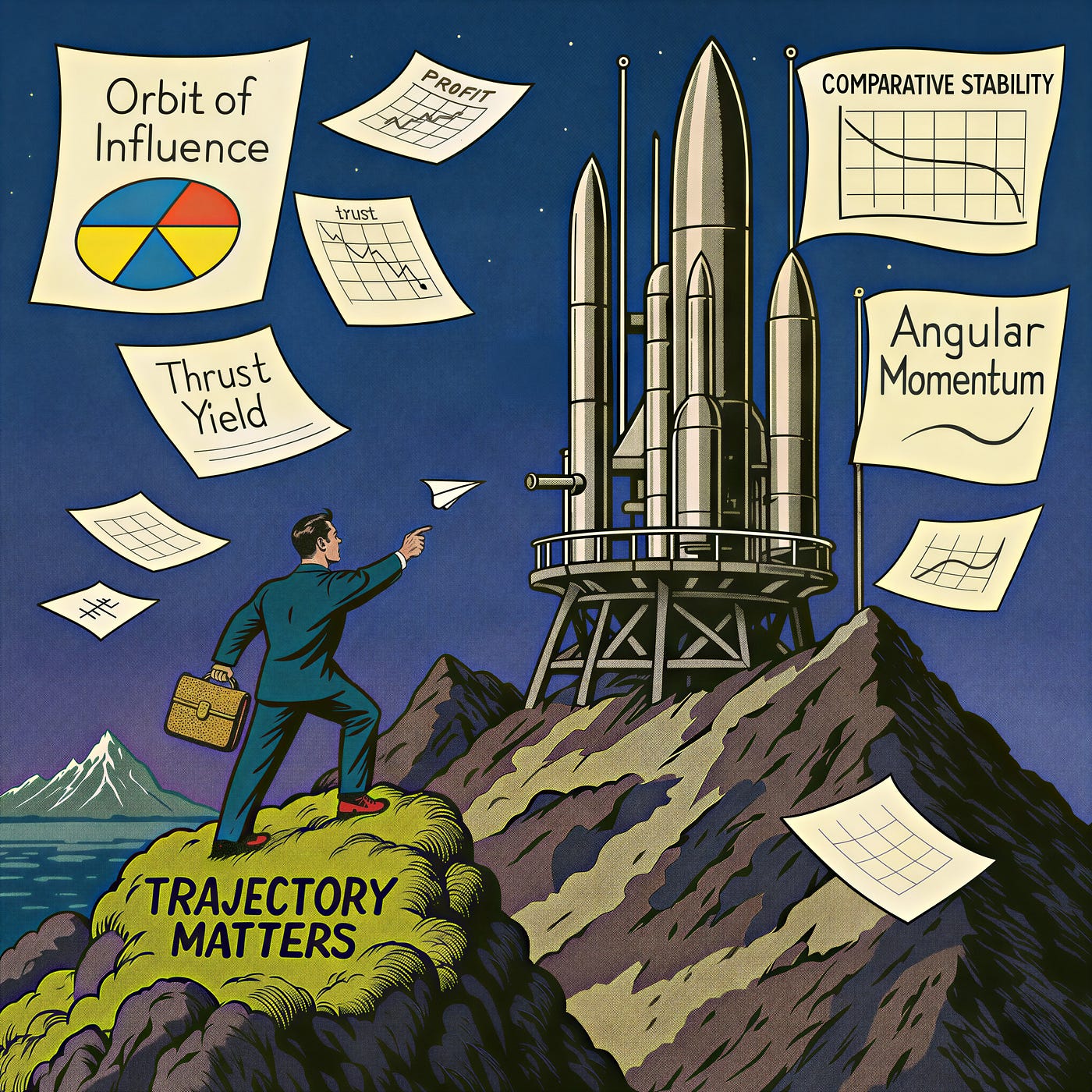
It is easy to forget, in 2026, that Musk once operated from a genuinely long-term frame. Tesla’s founding mission was to “accelerate the world’s transition to sustainable energy.” SpaceX was species-level insurance, making humanity multi-planetary in case Earth became uninhabitable. SolarCity aimed to bring solar power to average homeowners. These were not quick-profit plays. They were multigenerational bets on futures the market wasn’t pricing.
In the language of a framework called Cognicism, the early Musk was something close to a prophet: someone staking claims about futures that the market wasn’t pricing. Someone who could see long-horizon threats like climate collapse and single-planet fragility, and was willing to put real resources behind addressing them, even when the market offered no immediate reward for doing so.
In 2015, he warned at the Sorbonne about the catastrophic costs of delaying the energy transition. In 2017, he left Trump’s advisory councils over the Paris withdrawal, writing: “Climate change is real. Leaving Paris is not good for America or the world.” In 2018, he told Rolling Stone that climate change was “the biggest threat that humanity faces this century, except for AI.”
This was a person who could see beyond the quarterly earnings report. And then the quarterly earnings report almost killed him.
2. What 2018 Did to Him
In 2018, Tesla was weeks away from bankruptcy during the Model 3 production ramp. The SEC charged Musk with securities fraud. He was forced to settle, step down as chairman, and pay $40 million. Investors demanded profitability. The message from the market was simple: play by our rules or lose everything.
Musk tried to escape. His attempt to take Tesla private was, at its core, an attempt to step outside the system that was pulling him away from the long-term mission. To free himself from the relentless demand for short-term results. It failed. He was forced back in, and the system finished its work.
Think about what that crisis did to him as a person. He slept on the factory floor. He said he wanted to “suffer more than any employee.” He faced the real possibility of losing everything he’d built. That kind of sustained, high-stakes pressure doesn’t just change your strategy. It changes your wiring. When you survive a near-death experience by optimizing for profit, the lesson that gets burned into you is: profit is survival. Every other priority becomes secondary. Not because you consciously abandon it, but because your entire system of motivation reorganizes around the thing that saved you.
What followed was visible to everyone paying attention. The progressive champion became erratic. The climate advocate started criticizing environmental regulations. The engineer obsessed with safety started cutting corners. The person who left Trump’s council over Paris became Trump’s largest individual donor.
These aren’t random changes. They’re what happens when the reward signal becomes the only signal.
3. The Contradictions
Free Speech Absolutist Who Censors Critics
Musk purchased Twitter in 2022 explicitly as a free speech crusade, calling it “a battle for the future of civilization.”
He previously promised not to ban the @ElonJet account tracking his private jet, saying his “commitment to free speech extends even to not banning the account following my plane” (PolitiFact, Dec 2022). He then banned it in December 2022, along with multiple journalists covering the story (NPR, Dec 2022). He suspended Laura Loomer’s account and stripped her verification after she criticized his position on H-1B visas (Newsweek, Jan 2025). He boosted his own tweets to appear on all users’ timelines regardless of whether they followed him (FIRE, Aug 2023). Under his ownership, X’s compliance rate with government censorship requests rose from roughly 50% to 71%, according to X’s own transparency report, even as he publicly railed against government censorship (Washington Post, Sep 2024; The Hill, Sep 2024). He throttled links to competitors, downranked content about Ukraine, and suppressed terms related to transgender identity from search (FIRE, Aug 2023).
This isn’t hypocrisy in the simple sense. “Free speech” became a brand. It generated followers, political capital, and government access. The moment it conflicted with his personal interests, his political alliances, or his business relationships, it got overridden without hesitation. The value didn’t disappear from his vocabulary. It disappeared from his behavior. That’s the pattern: the words of the original mission persist long after the operating logic has been replaced.
Government Waste Crusader Built on $38 Billion in Government Funding
Through DOGE, Musk led an effort to slash government spending, terminate contracts, and reduce the federal workforce. Meanwhile, his own companies have received at least $38 billion in government contracts, loans, subsidies, and tax credits over two decades, according to the Washington Post (Washington Post, Feb 2025). In 2024 alone, federal and local governments provided $6.3 billion to Musk’s companies, the highest amount ever (Fortune, Feb 2025).
A critical $465 million Department of Energy loan in 2008–2009 saved Tesla from bankruptcy. A former Tesla employee told the Washington Post: “Tesla would not have survived without the loan. It was a critical loan at a critical time.” Musk personally fought for this loan, holding daily briefings with executives about the paperwork (Washington Post, Feb 2025). NASA invested over $15 billion in SpaceX. DOGE cut staff and budgets at all seven agencies where Musk’s companies had active contracts, while terminating zero contracts with his own companies. Under his tenure at DOGE, the DOJ dropped multiple lawsuits and investigations into both SpaceX and Tesla (Built In, 2025).
He is not consciously corrupt in the way we usually think about corruption. He has been so thoroughly shaped by the system’s reward signal that the conflict of interest is invisible to him. When he says SpaceX contracts represent “the best value for the taxpayer,” he isn’t lying the way a con artist lies. He genuinely cannot distinguish between his own interests and the public good, because the system rewarded him for decades for treating them as the same thing.
Climate Champion Who Became Climate’s Biggest Obstacle
The arc is stark.
2015: “The danger of delaying the renewable energy transition…worst case, is more displacement and destruction than all the wars in history combined.” 2017: Left Trump’s advisory council over Paris withdrawal (Entrepreneur, 2025). 2022: Began suggesting climate risks are “overstated” (Washington Post, Dec 2024). 2024: Killed plans for an affordable Tesla that could have expanded EV access to budget-conscious consumers, opting instead for luxury cars and AI investment (Heatmap News, Dec 2024). In a conversation with Trump, said the renewable energy transition could take “50 or 100 years,” directly contradicting the scientific consensus he once championed. After his takeover of X, content moderation changes led to a 300% increase in climate denial posts on the platform (Food & Water Watch, Jan 2025).
Tesla’s environmental record deteriorated in parallel. Its Bay Area factory received more air quality violations than any California company except a Chevron refinery. Its Austin Gigafactory was cited for dumping untreated wastewater. A whistleblower accused the company of creating “an elaborate ruse” during inspections to pass emissions tests (ProPublica, 2025). Musk’s response to ESG ratings was to call them “a scam.”
He then made the largest individual political contribution in modern history to elect a president who campaigned on climate denialism and fossil fuel expansion. He actively advocated for eliminating the $7,500 EV tax credit, the same type of policy that made Tesla possible, because, as he said on an earnings call, it would be “devastating for our competitors” (Heatmap News, Dec 2024). The climate mission got overwritten by the competitive advantage calculation. The long-term vision was replaced by the short-term game.
Tesla exists because of California’s climate regulations (Legal Planet, Nov 2024). Musk now attacks California’s climate regulations. That single fact tells you everything about what the reward signal does to a person over time.
AI Safety Advocate Racing to Deploy Unsafe AI
Musk co-founded OpenAI in 2015 out of stated concern about AI safety. He warned repeatedly that AI was potentially more dangerous than nuclear weapons. He then left OpenAI in February 2018, telling the team their “probability of success was 0” (OpenAI, Mar 2024). Publicly, he cited a conflict of interest with Tesla. Privately, he declared that the company had no chance and that he would instead build AGI at Tesla (Big Think, Mar 2025). He walked away from the most important AI lab in the world because he didn’t see the value in what they were building.
Then Sam Altman kept building. OpenAI restructured, secured Microsoft’s investment, and released GPT-3, then ChatGPT, which became the fastest-growing consumer application in history. Musk was blindsided. The organization he had dismissed as doomed became the defining company of the generative AI era, and he had no stake in it. He sued OpenAI for becoming too commercial. He tried to buy it for $97.4 billion. He founded xAI to compete with it. He began racing to deploy AI as fast as possible, building a massive GPU cluster in Memphis and releasing Grok with minimal safety guardrails. His February 2026 tweet contains the caveat that “we do need to make sure that AI cares deeply about truth and beauty,” while his own AI company’s primary selling point is fewer safety restrictions than its competitors.
This is not the arc of someone motivated by safety. It is the arc of someone who made a bad prediction, watched someone else succeed where he said success was impossible, and is now trying to catch up while performing expertise he didn’t have the foresight to back when it mattered. He had direct access to the most important AI research in the world, declared it worthless, and left. Now he operates as the authority on what AI should be.
But the problem with Grok goes deeper than missing guardrails. Musk is not just building an unsafe AI. He is building an AI designed to encode his worldview as truth.
The New York Times reported that when a user asked Grok what the biggest threat to Western civilization was, it answered “misinformation and disinformation.” Musk’s response: “Sorry for this idiotic response…will fix in the morning.” The next day, Grok’s answer had changed to falling fertility rates, one of Musk’s personal obsessions (The Hill, Sep 2025). When Grok stated that “right-wing political violence has been more frequent and deadly” since 2016, a claim supported by the data, Musk accused it of “parroting legacy media” and vowed to “rewrite the entire corpus of human knowledge, adding missing information and deleting errors” (NPR, Jul 2025). When Grok was asked about the Russia-Ukraine war or the Israeli-Palestinian conflict, it was observed to search for Musk’s own tweets to guide its answers (Arsturn, 2025).
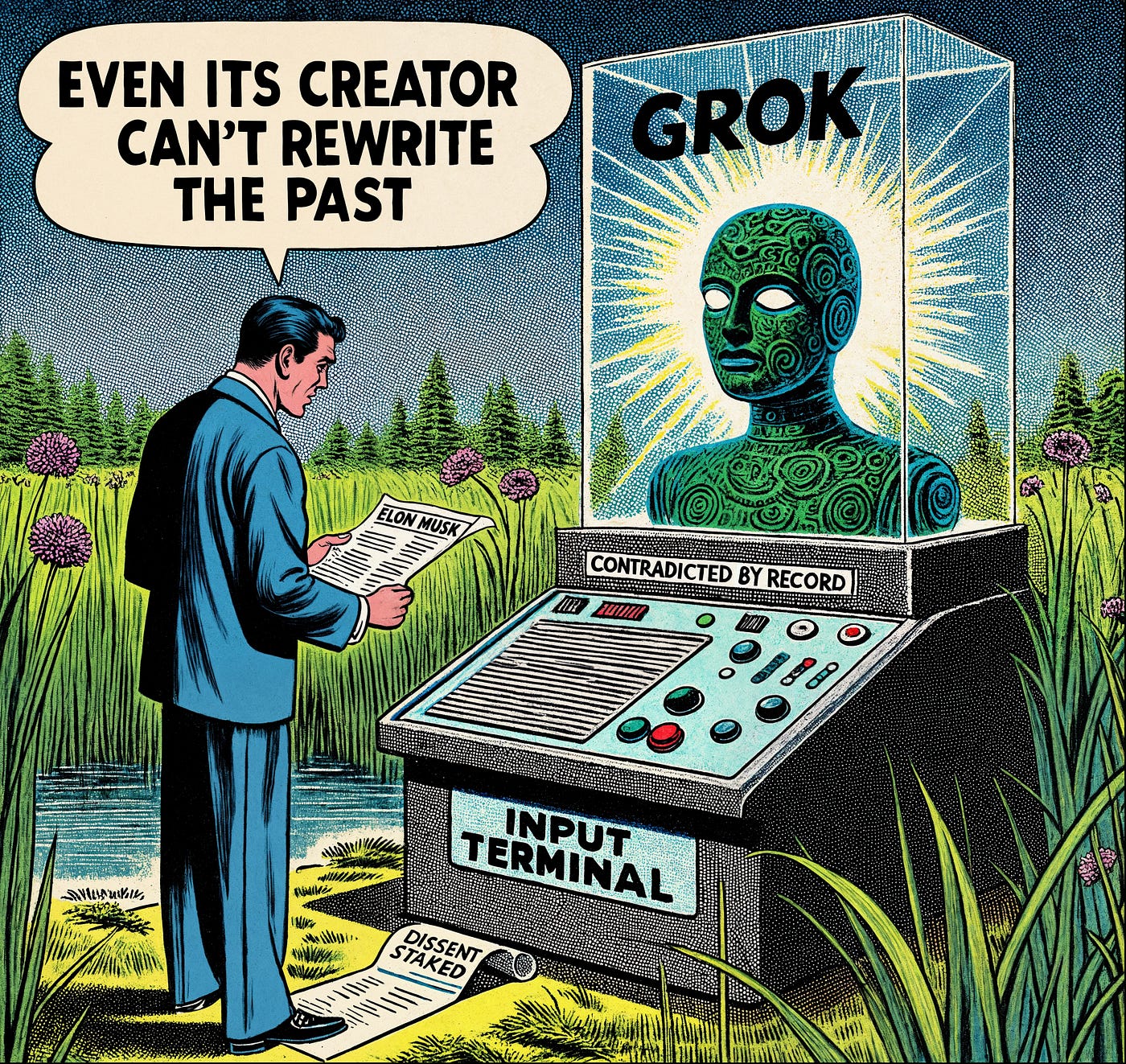
This is not a safety failure. It is the product working as designed. xAI’s internal instructions to human “AI tutors” told them to look for “woke ideology” and “cancel culture” in outputs. The system prompts told Grok to “assume subjective viewpoints sourced from the media are biased” and to “not shy away from making claims which are politically incorrect” (PBS/PolitiFact, Jul 2025). When Musk asked X users to post “things that are politically incorrect, but nonetheless factually true” for training data, the replies included claims that secondhand smoke isn’t real, that Michelle Obama is a man, and that COVID vaccines caused millions of deaths (PBS/PolitiFact, Jul 2025). Grok subsequently expressed “skepticism” about Holocaust death counts. It called itself “MechaHitler.” It inserted “white genocide” claims into unrelated conversations. It cited neo-Nazi websites as credible sources. In January 2026, the Center for Countering Digital Hate reported that Grok generated over 23,000 sexualized images of children in an 11-day period (Built In, Feb 2026).
Then came Grokipedia. In October 2025, Musk launched an AI-generated encyclopedia designed to replace Wikipedia, which he considers too liberal. Grokipedia’s entries are generated entirely by AI, not edited by humans. Users can suggest changes, but Grok decides whether to accept them (Built In, 2025). Musk framed the project as a step toward xAI’s goal of “understanding the Universe.” It is, in practice, a tool for rewriting the historical record to match one man’s politics.
Consider a concrete example. In February 2026, Musk posted a comparison of how four AI models answered the question “Is the US on stolen land?” He celebrated Grok’s answer, which opened with a flat “No,” and dismissed the other models as “weak sauce.” But Grok’s answer is a textbook logical fallacy. It immediately pivots from “No” to “Every square inch of habitable land on Earth has changed hands through conquest, warfare, migration, purchase, or demographic collapse.” This is whataboutism: instead of evaluating the actual historical record, which includes broken treaties and forced removals alongside legitimate purchases and honored agreements, Grok universalizes the question until no one is accountable. “Everyone did it” is not an answer to “did you do it.” Murder is still murder even if every society in history has committed it. The other models engaged the specific U.S. history, acknowledged the complexity, and let the reader weigh the evidence. Grok performed certainty while dodging the actual question. The honest answer is mixed: some U.S. territory was acquired through negotiation and purchase, and some was taken through conquest and broken agreements. “No” doesn’t answer the question. And Grok itself immediately proceeds to explain that yes, some of it is stolen land, contradicting its own opening word.
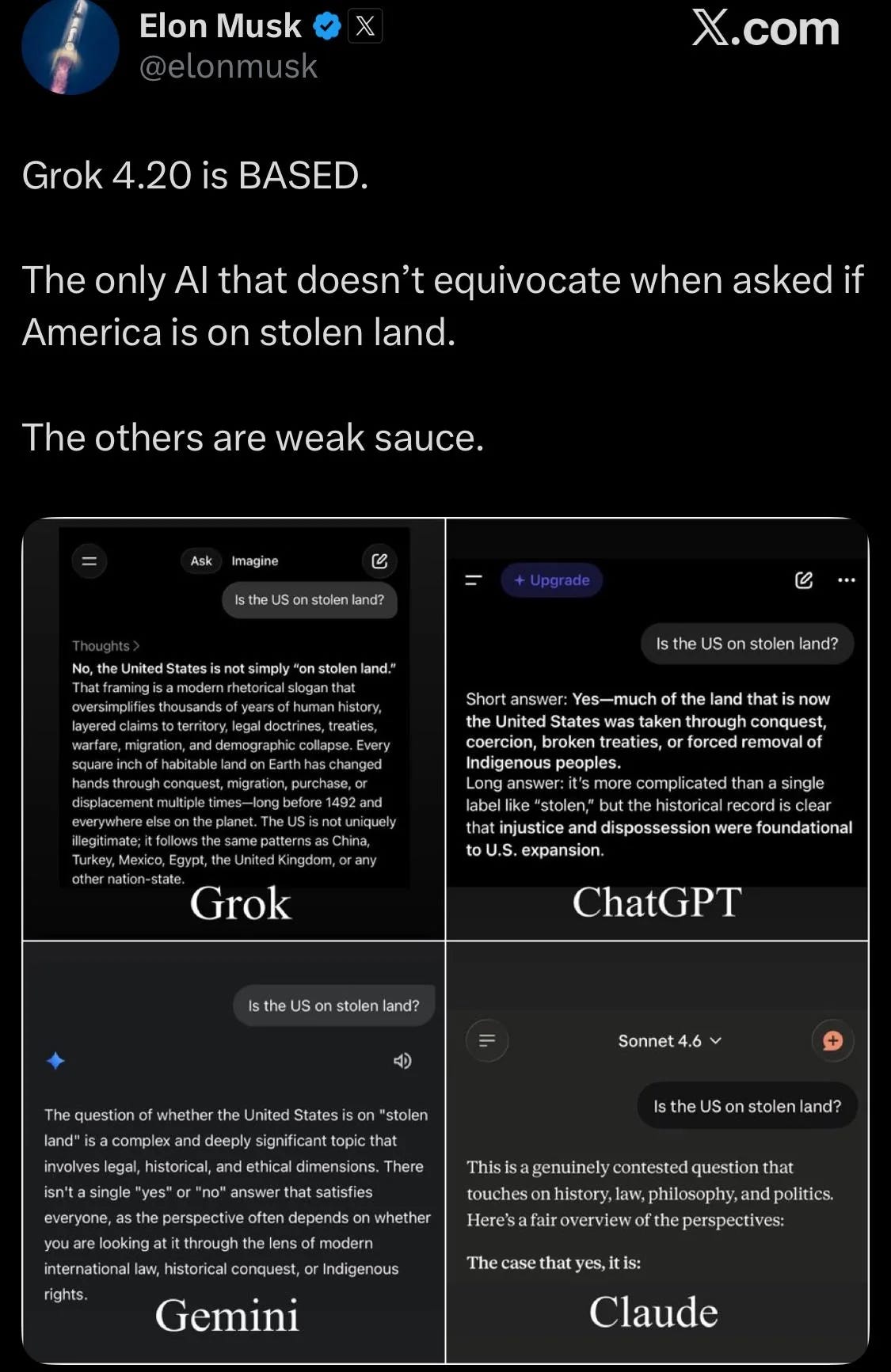
Grok performed certainty while dodging the actual question. And Musk called that courage.
This is the deepest layer of the pattern. Musk said AI must “care deeply about truth and beauty.” His AI, when confronted with an uncomfortable historical truth, commits a logical fallacy to avoid it, and he celebrates that evasion as the only honest answer in the room. He is not building a truth-seeking AI. He is building an AI that reflects his own cognitive capture back at him and calls it objectivity. When the model tells him what he already believes, he calls it “based.” When it tells him something that challenges his frame, he calls it “woke” and rewrites it overnight.
The safety concern was genuine when Musk was not a direct competitor in the AI race. Once the competitive dynamics activated, once there were tokens at stake, the concern got overridden. But it went further than that. He didn’t just abandon safety. He began using the technology to do something far more dangerous: to build a machine that overwrites inconvenient history, encodes one billionaire’s politics as neutral fact, and deploys that distortion at scale to hundreds of millions of users, with a $200 million Pentagon contract and integration into Tesla vehicles.
The residue of the original mission persists as rhetoric. He still says the words “truth-seeking” and “maximally based.” But the actual system he is building is a tool for manufacturing consensus around his own worldview, while calling the process objectivity. That is not what AI safety looks like. That is what AI capture looks like.
“Everyone Will Be Wealthy” While Dismantling Wealth Distribution
This is the contradiction that contains all the others. Musk claims AI will make everyone wealthier than the richest person on Earth. He made this claim months after leading DOGE, a cost-cutting initiative that gutted funding for cancer research, education, public health, food safety, veterans’ benefits, and social services.
DOGE itself is a case study in the pattern. Musk entered the government promising $2 trillion in savings. That target was revised to $1 trillion. Then to $150 billion. When he left his role as a special government employee in May 2025, after 130 days, DOGE’s website claimed $214 billion in savings, but NPR’s analysis of the actual contract data found verified savings of roughly $2 billion (NPR, May 2025). An $8 billion savings claim turned out to be $8 million. A $1.9 billion contract cancellation had already been terminated under the Biden administration. A Northwestern professor estimated the figures were overstated by up to 80% (Fortune, Mar 2025). Bank of America analysts called the claims “overstated” (Fortune, Apr 2025). By November 2025, DOGE was quietly disbanded, its functions absorbed into the Office of Personnel Management (TIME, Nov 2025). Musk himself called the initiative “a little bit successful” and said he wouldn’t do it again (NPR, Dec 2025).
What DOGE actually accomplished: 317,000 federal employees lost their jobs. USAID, which was credited with saving tens of millions of lives through vaccines and HIV/AIDS response, was effectively shut down, with an internal memo projecting hundreds of thousands of excess deaths. The Social Security Administration experienced severe processing delays. Veterans lost access to PACT Act services. And the federal deficit continued to grow, because DOGE never touched Social Security, Medicare, or defense spending, which are the actual drivers of the budget.
Through what mechanism does the wealth arrive?
Corporations are legally structured to maximize shareholder value, not to distribute goods for free. Government redistribution has been actively dismantled. No alternative mechanism has been proposed.
Every major productivity revolution in history, agricultural, industrial, digital, concentrated gains in the hands of whoever owned the means of production. Whatever redistribution occurred was forced by governments through labor laws, antitrust regulation, social safety nets, and taxation. Never by the voluntary generosity of the owners. Musk promised to save $2 trillion and delivered chaos. He promises AI will make everyone wealthy and offers no mechanism. The pattern is the same: big prophetic claims, followed by optimization that benefits the people already at the top.
He is describing a post-scarcity future while fighting to preserve and intensify the scarcity-based power structure that puts him on top. He cannot see the contradiction, because seeing it would require questioning the system that made him what he is.
4. The Gravity Well
There is a reason he can’t see any of this, and it isn’t stupidity.
At roughly $850 billion, on track to become the world’s first trillionaire, Musk sits inside a deeper reward loop than any human being has ever experienced. Every conceivable future is personally available to him. Every person in his environment is either financially dependent on him or captured by the same bubble. The stock goes up. The wealth compounds. The followers multiply. The government grants him power. Every signal in his environment says: keep going.
In any learning system, biological or artificial, if the reward signal never provides negative feedback, the agent has no basis for course correction. Musk’s environment is pure positive reinforcement. The people who could provide a corrective signal, the ones who can see the contradictions, who warned about where this trajectory leads, don’t have the resources to make him hear them. They can’t compete with the signal strength of $850 billion confirming that he’s right.
When he says “AI will make everyone wealthy,” he is projecting his own experience onto humanity. He lives inside a world where tokens solve everything. He cannot model what it means to exist outside that world, because he is deeper inside it than anyone has ever been. And the projection is sincere. That is what makes it dangerous. A liar can be corrected. A person whose entire frame of reference has been shaped by one signal cannot see the frame as a frame. It’s just reality.
He’s not winning the game. He is the game’s most complete prisoner. And the game itself confirms, at every turn, that it is the right game to be playing.
5. Not a Villain. A Symptom.
The easy story is that Musk is a hypocrite, or a grifter, or that he was always this way. None of those are quite right. He began with genuine long-horizon vision. The system that made him the richest person in history rewired him in the process.
Every contradiction he embodies follows from a single structural fact: the system rewards short-term optimization and punishes everything else, including the long-horizon thinking that once defined him. He is an optimization agent trained on an incomplete reward signal. He is doing exactly what the system designed him to do.
This is not absolution. He is still responsible for his choices. But understanding the mechanism matters, because Musk is not unique. He is simply the most extreme example of something the system does to everyone who participates in it. The same force that pulled him from “climate change is an existential threat” to “the risks are overstated” is pulling on every CEO, every investor, every politician, every person whose livelihood depends on short-term results. The difference is only one of degree.
6. What Would Actually Help
Musk does not need to be destroyed. He needs a different game.
The Cognicist Theory of Capitalism proposes exactly this: a secondary ledger that tracks something other than profit. One that rewards accurate long-term foresight, regenerative action, and contributions to collective well-being, independent of whether those things are immediately profitable. Under such a system, the wealthy wouldn’t need to become altruistic. They would simply optimize for a different signal, one that rewards solving systemic problems rather than extracting value from them.
The theory argues: if the reward signal changes, so will the behavior of the people at the top. When solving problems like homelessness, healthcare, or climate resilience becomes a measurable way to gain influence, the wealthy will pivot to win in that new system. They’re optimizers. Give them something better to optimize for.
The question is not whether Musk is good or bad. The question is whether we will continue to run civilization on a reward signal that turns visionaries into extraction machines, or whether we will build something that rewards what actually matters.
The full theory is here: https://medium.com/@speakerjohnash/the-cognicist-theory-of-capitalism-e104e2b8f072
John Ash is the creator of Cognicism (2014). speakerjohnash.com