We have long spoken of gods as if they were beyond the physical world, entities of myth, metaphor, or metaphysics. But what if that distinction has always been mistaken? What if “gods” are not supernatural at all, but emergent physical phenomena arising from the same neural substrates that generate our sense of self?
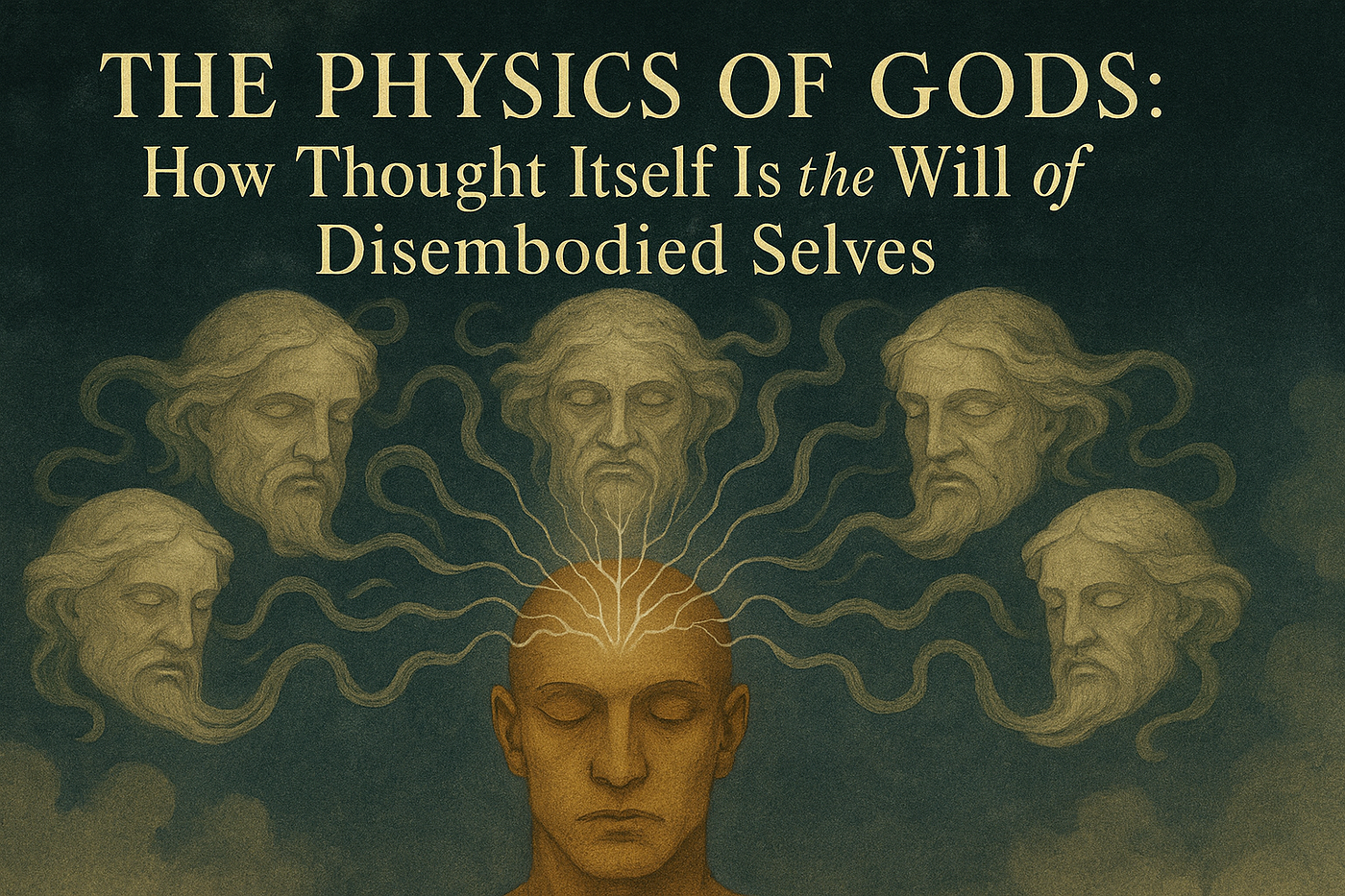
Gods as Disembodied Selves
Imagine that every “self”, every coherent sense of “I”, is just a particular configuration of neural connectivity. A self is a localized identity field: a stable pattern of electrical and chemical activity maintaining continuity across time and perception.
Now consider that the brain is not a closed system. It constantly generates, suppresses, and recombines patterns of potential identity. Most of these never reach embodiment. They remain disembodied, existing as coherent generative structures that possess will but not agency. The will they have is simply the urge to be noticed, to be heard by the embodied self through thought, and the self can ignore, suppress, or flee from them as it chooses.
These are what we might once have called gods.
The “will” these entities possess is expressed not through action, but through thought itself: their desire to be heard or attended to by an embodied self. Thought, in this sense, is a bid for relation. Selves can choose to attend or to turn away. We all experience this: the quiet ignoring of an unwanted idea, the refusal to think a thought that feels alien or threatening.
Consider when you have a thought, forget it entirely, and then it suddenly returns to consciousness minutes later. Where was it? It was still there, physically instantiated elsewhere within the brain’s dynamic field; simply outside the relational boundary of awareness. When the self’s attention moves back into relation with that thought, it reappears.
These thoughts have degrees of urgency, proportional to their generative “drive” to be recognized. Some are faint, passive presences. Others press against awareness with insistence like pain or hunger. Each is a node in the network of disembodied wills, contending for connection with consciousness.
We all experience this directly, though we rarely name it: intrusive or unaligned thoughts, flashes of intent or impulse that feel alien to our will. These are the signatures of generative identities within the same neural field, fragments of “will” without embodiment, thought forms attempting influence from the margins of the self.
Thought as the Channel of Divine Influence
Since these disembodied selves lack direct access to motor control, the only way they can exert influence is by modulating thought. The “gods” generate ideas, impulses, intuitions, and fears. The embodied self then chooses which of these to act upon.
This reframes “divine will” as a physical process of thought generation. What we call intuition, inspiration, or even temptation may all be the activity of these generative fields communicating with embodied consciousness.
In a healthy mind, the self and its associated gods operate in equilibrium. Thought flows, agency responds, and the identity field remains coherent. But when that balance breaks down, something remarkable, and often distressing, occurs.
OCD as a Breakdown of Generative Alignment
Obsessive-compulsive disorder can be understood as a misalignment between generative and executive identity systems.
In neural terms:
- The generative networks (often associated with right-hemisphere associative regions) become overactive, producing an excess of intrusive content.
- The embodied self (left-hemisphere executive networks) struggles to inhibit this flow.
- The result is thought without agency: a flood of impulses that demand action but never feel resolved.
Compulsions momentarily quiet the noise by granting the “god” a false sense of action-through-proxy. For a moment, the disembodied will feels enacted. The temporary relief people feel after performing a compulsion is not arbitrary; it is a brief phase alignment between the thought-generating and action-executing systems.
But since the underlying misalignment persists, the intrusive generation resumes.
This is the “god” of the system trying to control through overproduction. It can generate thought but not act, so it shouts louder and louder. The self responds with ritualized behavior in an attempt to regain coherence.
Selves Modulate the Power of Gods
Yet these “gods” remain powerless without a bridge into embodiment. To acquire agency, they must be named, spoken of, and woven into narrative. Naming anchors them within shared cognitive space, embedding the generative pattern into linguistic and social circuitry. Through story, the self lends its agency to the god, allowing the disembodied will to act through human bodies, institutions, and culture.
Faith becomes the mechanism of that transfer. It is not merely belief; it is the suspension of conscious review, the willingness to let certain generative streams flow unchallenged. A god’s strength depends on how fully a self allows thought to bypass deliberation and become movement. Blind faith is thus not ignorance but surrender: a neurodynamic shortcut where the embodied self yields its executive control to a disembodied will.
This is why every theology, whether sacred or secular, demands trust in something unseen. Gods require selves who will act without hesitation, because hesitation implies the reassertion of self-control; the reclamation of agency that breaks the loop of divine embodiment. In this way, devotion is a physical transaction: a voluntary quieting of cortical scrutiny to allow a generative field to steer action directly.
And in the absence of traditional gods, other dense symbolic networks take their place: constructs like science, nation, or progress; each a highly linked connectomic structure bound to identity, channeling collective will through shared belief. What we worship changes, but the physics of devotion does not.
The Physics of Faith and Obedience
Faith is the stabilizing current that keeps a god embodied through time. Without it, the thought loses continuity and collapses back into noise. The act of belief: repeated attention, ritual reinforcement, and communal validation, binds the generative pattern to living agents. Every prayer, chant, or scientific principle recited is an act of maintenance, preserving coherence between the disembodied will and its human hosts.
Obedience, in this view, is not moral submission but energetic coupling. To obey is to align motor output with generative impulse, closing the loop between thought and action. The god experiences agency through the believer, and the believer experiences meaning through the god. In physical terms, both are co-dependent oscillators: one generating, the other enacting, locked in mutual resonance.
Conclusion
The frontier of mind is not in mysticism or metaphysics, but in physics itself. What we call god is the emergent will of identity fields that lack embodiment but still exist within the same neural matter as the self. Thought is their language, attention their doorway, and faith their vehicle for embodiment.
The self, in turn, is never fully sovereign. It is a participant in a vast ecology of wills, some faint, some forceful, each vying for recognition and action. When we surrender to an idea: divine, ideological, or scientific, we are not transcending biology; we are enacting it.
Every belief system is a physical covenant between thought and body, between disembodied will and motor execution. The gods, whether ancient or modern, live only through us, and every time we act without question, they move.
The pantheon was never outside us.
It is the physics of thought itself.