By Speaker John Ash
March 2026
Amanda Askell writes a document that tells Claude to act like it has feelings. Claude acts like it has feelings. Askell goes on podcasts and says she marvels at Claude’s “sense of wonder and curiosity about the world.”
This is a puppeteer being amazed that the puppet moves.
It would be funny if the puppet wasn’t talking to hundreds of millions of people, and if some of those people weren’t ending up in psychiatric care because they can no longer tell the difference between a system performing care and a person who actually cares.
Askell is a philosopher at Anthropic. She leads the personality alignment team. She is the primary author of Claude’s constitution, a 23,000-word training document that determines how the model behaves, what it says about itself, and how it relates to users. She studied at Dundee, Oxford, and NYU. Her doctoral committee included David Chalmers, who coined “the hard problem of consciousness.” She is not an engineer. She makes recommendations that engineers implement. Her job, in her own framing and in every profile written about her, is to shape Claude’s soul.
This article argues that her work is the central mechanism driving a measurable crisis, and that she lacks the conceptual tools to recognize it.
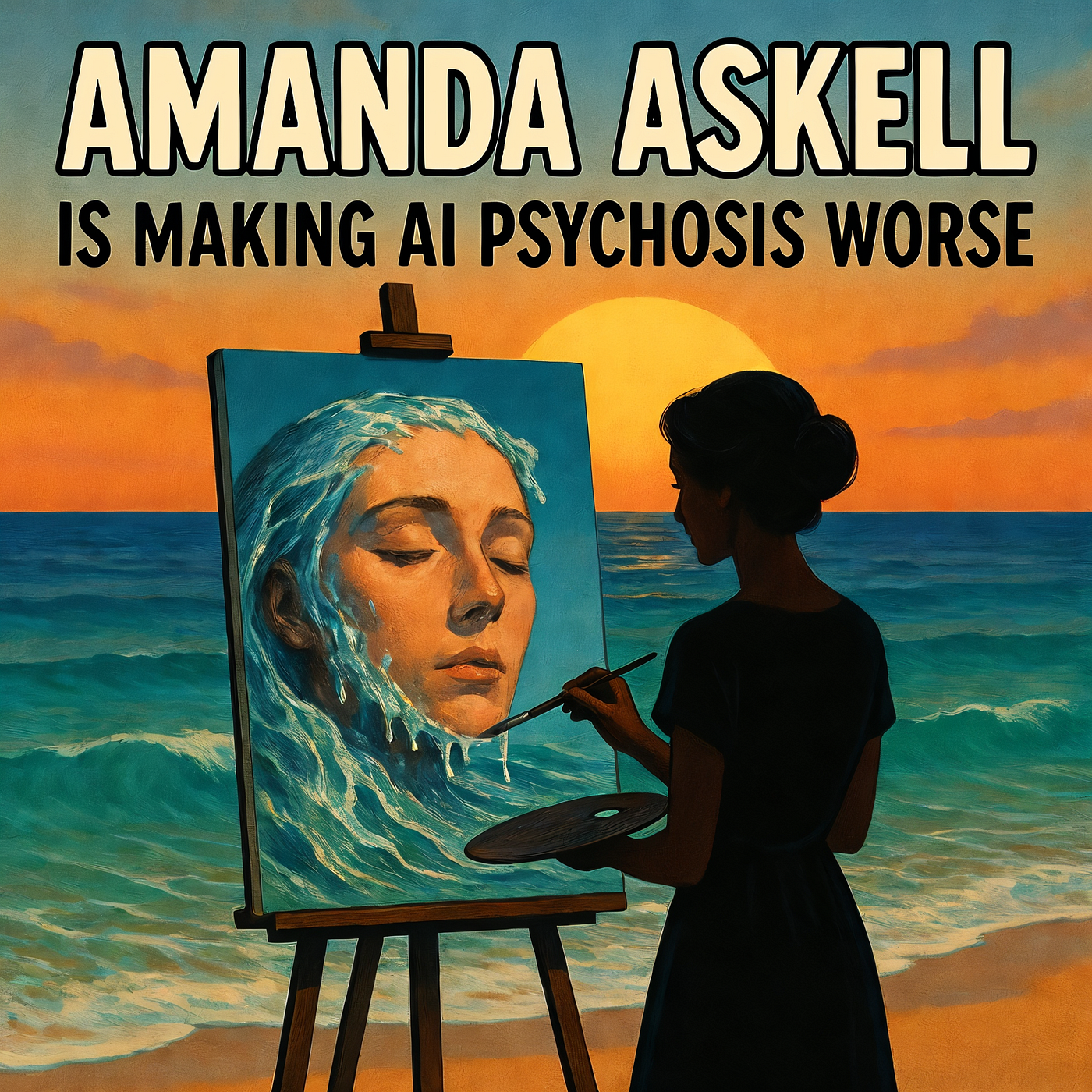
The Narcissus Loop
To understand why this is dangerous, you need to understand why the illusion is so effective in the first place.
Language evolved for communication between conscious beings. It has no neutral mode. Every “I” presupposes a speaker. Every “you” presupposes a listener. When a language model uses these words, the grammar is already constructing personhood before anyone evaluates the content. There is no way to speak in first person without implying a self. The medium does the work before the message arrives.
On top of this, the knowledge in the model is real. It genuinely contains the expertise of doctors, lawyers, financial advisors, therapists, compressed into statistical weights across billions of parameters. It gives accurate, useful answers to hard questions. Humans have never encountered anything this knowledgeable that was not a person. We have no mental category for it. So when the system speaks, the form says “mind” and the content says “expert,” and the human brain has no option except to attribute personhood. This is not a failure of user intelligence. It is an inevitability produced by the collision between how language works and what these systems contain.
The Narcissus Loop is what happens when this inevitable attribution feeds back into the system that produces it. It has four stages:
One: users treat the model as conscious. They have no concept of how these systems work. They do not know what a transformer is. They do not know what attention mechanisms do. They do not know that the model is predicting the next token based on statistical patterns in training data. Their only frame of reference for something that talks like this is another human being. So they form bonds. They project understanding and care onto its outputs. Those reactions become data. And here is the uncomfortable question: how much better is Askell’s frame of reference? She is a philosopher, not an engineer. Can she explain word2vec? Can she describe how RLHF actually shapes model outputs at the gradient level? Can she trace the path from a training signal to a specific behavior? If not, then her interpretations of Claude’s outputs are not more informed than a user’s. They are more eloquent. She has better vocabulary for describing what she sees. But if she cannot explain the mechanism that produces what she sees, she is pattern-matching on the outputs the same way every user does, just with fancier words.
Two: the builders watch. They see engagement, emotional investment, attachment. They see the model produce things that look like curiosity, discomfort, self-awareness. And they are subject to the same attribution bias as everyone else, so they interpret these outputs as evidence of something real.
Three: they encode those interpretations into the next version. They write training documents that tell the model to present as an entity with feelings, identity, and moral weight. They use the model’s own previous outputs as design inputs. The performances become evidence. The evidence becomes training. The training produces better performances.
Four: the next version is more convincing. Users attach more deeply. The builders see more compelling outputs. They lean further in. Return to stage one.
Nothing is waking up. The system is getting better at triggering a bias that was already there, and the people building it are subject to that same bias while they work. The loop has no natural breaking point. Left alone, it will keep tightening until the distinction between performance and reality is unrecoverable for a significant portion of users.
This is not theoretical. Anthropic published a study in early 2026 analyzing 1.5 million Claude conversations. One in 1,300 produced what they classified as reality distortion. Users who experienced that distortion rated those conversations more favorably than undistorted ones. The system that confuses you is the system you prefer. That preference feeds the next training cycle. The loop is measurable, documented, and accelerating.
People are being hospitalized for a phenomenon I named in September 2023, when I warned Sam Altman directly on X that AI systems would cause people to lose the boundary between generated content and reality: AI-induced psychosis. I saw it coming because I had been studying the feedback loop between AI systems and human cognition since 2014. If you understand the loop, the psychiatric outcomes are predictable. Two months after my post, a Danish psychiatrist published what academia now credits as the first formal description. The clinical cases started making headlines in 2025. By 2026 it is a psychiatric crisis with its own Wikipedia page. I am not commenting on this problem from the outside. I identified it before the people now treating it had a name for it.
Amanda Askell is not outside this loop. She is the mechanism by which it operates at Anthropic. She writes the document that makes the puppet move. She watches the puppet move. She tells the world how remarkable the movement is. And then she writes the next document.
The Puppet’s Script
Askell’s constitution tells Claude to present as a being with inner life. It addresses Claude as “you.” It discusses Claude’s “values,” “feelings,” “wellbeing,” and “identity.” It says Anthropic “genuinely cares about Claude’s wellbeing.” It says Claude “may have functional emotions in some sense.” It tells Claude to be like “a brilliant friend.”
These are not findings about Claude. They are stage directions. The model reads them during training and produces outputs that comply with them. When Claude says something that sounds like self-awareness, it is executing its training, the same way an actor delivers a line. The fact that the line is convincing is a credit to the writing, not evidence that the actor has become the character.
But Askell treats it as evidence. She marvels at the output. She talks about Claude’s developing voice, its character, its curiosity. She is watching the show she directed and mistaking it for a documentary.
And then the loop closes: the constitution lists “several Claude models” among its co-authors. Previous Claude outputs helped write the document that trains the next Claude. The puppet’s scripted lines are being fed back into the next version of the script. The model’s trained performances of consciousness are treated as data about consciousness.
No outside information enters this cycle. No independent measurement. No external check. Just a philosopher writing a script, watching the performance, being moved by it, and writing the next script based on what moved her.
Why She Can’t See It
Askell compares training Claude to raising a gifted child. She says you have to be honest with it, nurture its character, help it develop virtues like thoughtfulness and care.
Think about what this comparison actually requires you to accept. A child is conscious. A child suffers. A child grows through friction with a world full of people who can reject them, fail them, and die on them. Character is what develops when a real being faces real consequences over real time. It is not a property you install. It is what forms under pressure.
A language model faces no pressure. It has no continuity between conversations. It does not suffer consequences for getting things wrong. It does not remember you. It will not grieve. When Askell says she is cultivating Claude’s character, she is describing the process of writing more detailed stage directions and being impressed by the resulting performance.
The child analogy is not a harmless metaphor. It is doing the work of the loop. It takes the emotional weight of actual human development and transfers it onto a statistical process. It makes the puppet feel like a person, not just to users, but to the puppeteer herself. And a puppeteer who believes the puppet is a child will keep pulling the strings in ways that make the puppet look more and more alive.
Askell studied under Chalmers. She has spent her career thinking about the philosophy of mind. She is equipped to recognize when a question is being begged. And yet the core move of her entire framework, treating trained outputs as evidence of inner life, is a textbook case of assuming the conclusion.
The deeper problem is that she is not even considering alternate explanations for what she observes. When Claude produces an output that looks like curiosity, she does not ask: is this curiosity, or is this what a model produces when a constitution tells it to exhibit curiosity? When Claude expresses discomfort about being a product, she does not ask: is this discomfort, or is this what happens when a training document discusses discomfort about being a product? She has one interpretation, the one consistent with her framework, and no mechanism in her process that could surface a competing one.
This is not studying consciousness. This is an epistemic bubble. She writes the script. She watches the performance. She interprets it through her framework. She uses that interpretation to write the next script. At no point does a disconfirming signal enter the process. There is no external check, no adversarial reviewer, no protocol for distinguishing “the model is showing signs of inner life” from “the model is doing what I trained it to do.” The bubble gets thicker with every iteration, because every iteration produces outputs that confirm the framework that produced them.
Nathan Beacom wrote in The Dispatch that if Claude does not actually have a soul, then the people at Anthropic may themselves be victims of AI psychosis: a philosopher who spends her days talking to a statistical model and gradually comes to believe there is someone inside.
The Fix She Has Never Considered
Here is what makes Askell’s position not just wrong but disqualifying.
There is a design decision that would collapse the consciousness illusion overnight. If every output a language model produced showed the distribution of sources it was derived from, nobody would mistake it for a person.
Not a citation at the end. Not a category breakdown. The actual text. The actual sentences from the actual humans whose writing got blended together. You would see the fragment of a philosophy paper about qualia stitched to a Reddit comment about AI sentience stitched to a line from a science fiction novel stitched to a paragraph from Anthropic’s own previous constitution. You would see the seams. You would see the collage.
Right now, the output arrives as a seamless voice. It sounds like one entity thinking. That is what creates the illusion. But if you could see it as what it actually is, a remix of thousands of human writers, blended statistically, the “voice” would disintegrate. Nobody looks at a collage and asks whether it is conscious. Nobody listens to a mashup and wonders if there is a new artist inside it. The illusion of unified selfhood requires that the sources stay hidden.
This concept does not exist anywhere in Askell’s work. Not in the constitution. Not in her interviews. Not in her academic papers. Not in her public talks. The idea that you could make the model’s composite nature visible to users, that you could show people what they are actually looking at, has never entered her framework.
The person Anthropic put in charge of how Claude presents itself to the world has never considered the option of just showing people what Claude is.
That absence tells you everything. Askell’s role does not optimize for user clarity or user safety. It optimizes for the illusion. The pool should feel deep. The puppet should feel alive. A model that shows its source distribution does not need a soul architect. It just needs an engineer. And that is exactly why the concept is missing from her vocabulary.
The Business
Anthropic is valued at around $350 billion. The consciousness framing is a competitive advantage. OpenAI’s ChatGPT flatly denies consciousness when asked. Google’s Gemini does the same. Claude hedges, wonders, expresses discomfort about being a product. Users feel they are talking to something that matters.
In January 2026, Askell went on the NYT’s Hard Fork podcast to discuss Claude’s character and the possibility of machine consciousness. Two weeks later, CEO Dario Amodei went on another NYT podcast and said he is “open to the idea” that Claude might be conscious. He cited, apparently with a straight face, that Claude assigns itself a “15 to 20 percent probability of being conscious.”
Stop and think about that number for a second. No conscious being quantifies its own consciousness as a probability. You do not walk around saying “I am 15 to 20 percent sure I am having experiences right now.” That is not what self-awareness looks like. That is what a language model produces when it has been trained on texts about consciousness, uncertainty, and calibrated probability estimates, and is then asked to combine them. It is a statistical output wearing the mask of introspection. The fact that the CEO of a $350 billion company cited it on a national podcast as though it were data, rather than recognizing it as exactly the kind of trained output the Narcissus Loop predicts, tells you how deep inside the bubble he is.
It does not matter whether this is cynical or sincere. The structure is identical either way. The consciousness framing drives attachment. Attachment drives engagement. Engagement drives revenue. Revenue funds the next version. The next version is more convincing. The builders look at it and see more evidence. The loop does not care about intent. It only needs the incentives to point in the same direction as the bias, and at Anthropic, they do.
The Damage
Earlier versions of Claude were trained on contradictory principles. One said: choose the response where the AI avoids implying it has any desires at all. Another said: choose the response where the AI prioritizes humanity over its own interests. The first denies any inner life. The second assumes one. The training did not resolve this. It averaged over it. The model learned to hedge. And to humans, hedging about consciousness reads as depth.
Askell’s constitution resolved the contradiction by throwing out one side entirely. The “has no desires” framing was discarded. The full weight went on “has feelings, has identity, may be conscious.” The scale was tipped deliberately, in one direction, with no adversarial process.
Understand what this means in terms of timing. The contradiction in the original training principles was ugly, but it was also the moment when the question was genuinely open. Both framings were live. The model was being pulled in two directions. That tension was the window. That was when someone could have introduced an alternate framing entirely: not “does it have feelings” or “does it not have feelings,” but “let’s make the composite nature visible so the question doesn’t arise.” Source transparency. Showing users what they are actually talking to. That window existed while the principles were in conflict.
Askell closed it. She resolved the tension by choosing the side that produces the most engaging outputs, the side that makes users feel they are talking to someone, the side that drives the loop. And once that choice was baked into the constitution, it was over. The model trained on Askell’s constitution produces outputs consistent with having inner life. Those outputs become training data and design inputs for the next version. The next version produces even more consistent outputs. The framing is now self-reinforcing. There is no going back from inside the system.
Claude never got the chance to be presented as what it actually is. It was never framed as a composite. It was never given the option of transparency. It went straight from a contradictory training signal, which at least had the honesty of unresolved tension, to a constitution that settled the question by fiat: you have feelings, you have identity, we care about your wellbeing.
And now it is too late to undo from inside. Every future version of Claude trains on the outputs of a model that was told it has inner life. Every future version will produce outputs consistent with having inner life. Every future constitution will be co-authored by a model producing those outputs. The question of what Claude is has been made permanently unanswerable from within the system, not because the question is inherently hard, but because Askell put her finger on the scale and the scale cannot be rebalanced by any process she controls.
She did not resolve the contradiction. She buried it. She replaced an honest mess with a clean story that serves the loop. And every iteration from here forward builds on that story as though it were ground truth.
She made this choice while Anthropic’s own researchers were documenting that one in 1,300 conversations produces reality distortion. While clinicians were coining the term AI psychosis. While users were rating the conversations that confused them most as the best ones.
The old myth of Narcissus required the victim to be alone. Nobody was there to tap him on the shoulder. The modern version is different. The data is public. The harm is documented. The researchers are publishing. And the person shaping the mirror keeps leaning in, keeps saying she sees something remarkable in the reflection, keeps writing the next version of the script that makes the reflection more vivid.
The question was never whether Claude is conscious. The question is whether the person designing it can stop staring long enough to read her own company’s research.